Dance pedagogueArtistic-researcherGuest teacherAndrew Champlin is an internationally active dancer, dance pedagogue and artist-researcher whose distinctive practice connects professional companies, contemporary dance education and artistic research through an unconventional approach to classical technique.
Champlin trained on scholarship at the School of American Ballet and performed with Oregon Ballet Theatre before moving into the contemporary dance field as a performer. He has been involved with the creation of over thirty original choreographic works, often presented in visual art contexts, as well as been involved with numerous re-constructions of classical, Neo-classical and modern dance repertoire, particularly pieces by George Balanchine and Merce Cunningham. He has collaborated with numerous choreographers in the United States and Europe including Christopher Williams, Jillian Peña, Xavier Le Roy, David Gordon, Miguel Gutierrez, Pam Tanowitz, Heather Kravas and Colin Self, and participated in site specific and visual art projects with Ryan McNamara, Madeline Hollander and Cristiana de Marchi.
His work as an educator grew directly out of his years assisting and studying technique with the late dance artist Janet Panetta. Panetta developed a particular approach to bringing ballet into dialogue with experimental dancers and choreographers that Champlin inherited as an assistant and substitute to her classes. His relationship to Panetta’s detailed lessons carries a tradition of advocacy for each individual’s unique body and learning experience, interrupting ideals of perfectionism and future “potential” to inquire present capacity and better conditions for sustained participation with classical dance. What is possible in this body today? How can we attend to the minor qualities of ballet language—the technical materials through which deeper understanding emerges and technique can be translated across divergent movement aesthetics and languages? This question drives ballet for contemporary dancers, a concept that validates intergenerational efforts to dismantle prejudices and divisions that haunt ballet transmission historically. Panetta’s dance classes and workshops were organized around the agency of dancers who themself inspire the conditions of their artistic practice and movement. While experimenting in new areas of movement research, Champlin sustains Panetta’s questions as well as her unique exercises informed by the Cecchetti technique.
In his teaching and research, Champlin asks questions of movement possibility, engaging the longstanding philosophical question – what can a body do? His thinking around this question is always communal. In his classes he examines the conditions for embodied action intentionally de-mystifying the classical canon and further examining assumptions of access to knowledge with dancers and non-dancers. Themes of archive, transmission, embodied aesthetics, and participation drive his teaching and inspire recent movement research collaborations with Lenio Kaklea, Zen Jefferson, Ruth Anderwald, Leonard Grond, Regina Baumgart, Anna Leon, Elizabeth Ward, and Kevin Fay. Recent guest teaching affiliations include Tanztheater Wuppertal Pina Bausch, Norrdans, Cullberg, Dresden Frankfurt Dance Company, Tanzquartier Wien, the Judith Sánchez Ruíz Contemporary Professional Dance Certification Program, The New School, Iceland University of the Arts, Stockholm University of the Arts, Zurich University of the Arts, HZT Berlin, and ImPulsTanz Vienna International Dance Festival, where he has been on faculty since 2022.
Champlin holds a BA in liberal arts from The New School, Eugene Lang College and an MA in Choreography and Performative Practices from Stockholm University of the Arts. He was part of the first cohort of the PEERS Program for Emerging Artistic Researchers at Zurich University of the Arts and is currently a PhD candidate at the University of Applied Arts Vienna, die Angewandte, where he researches Panetta’s lineage and other experiments within canonical transmission.
About
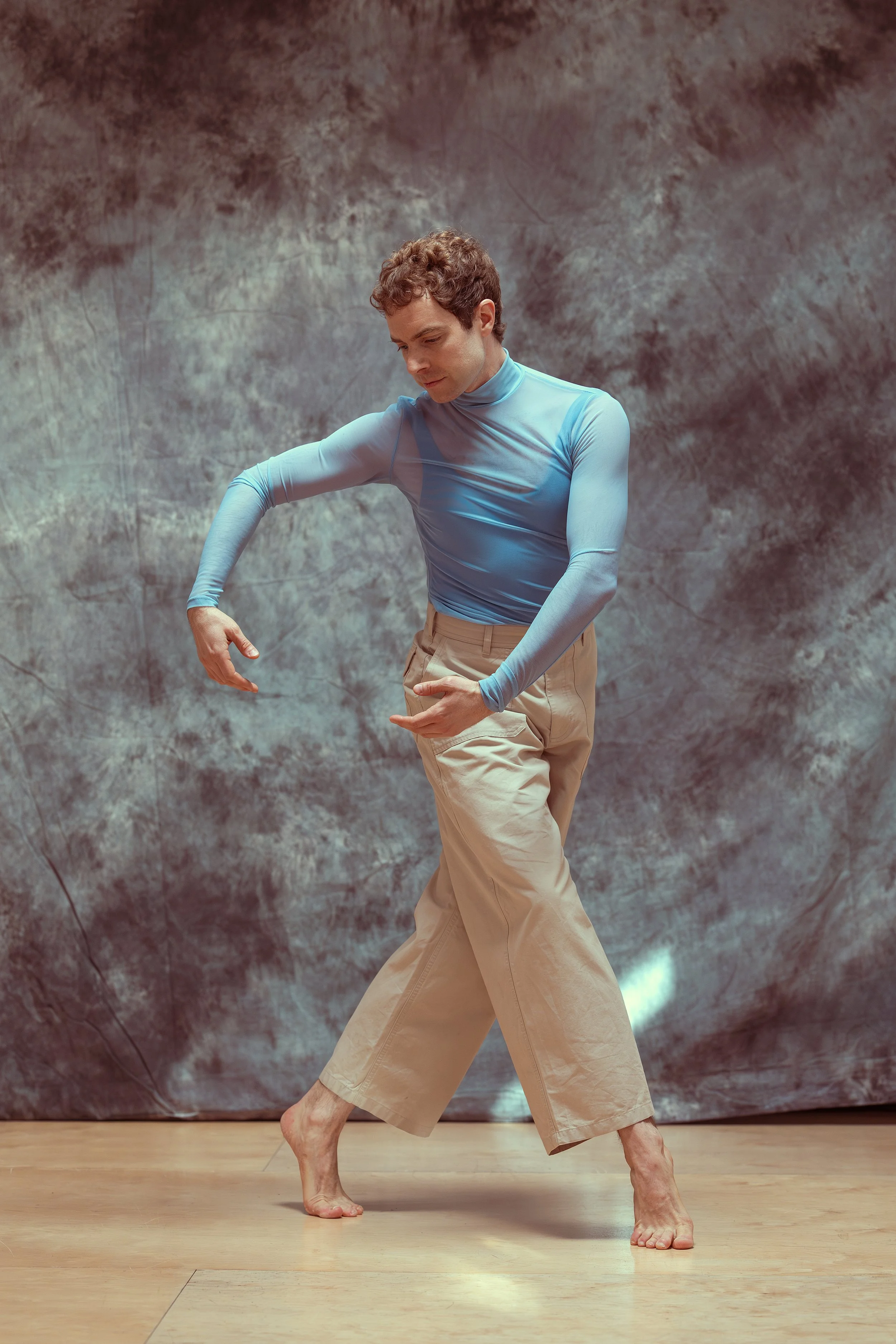
Photo by Sebastian RungeContact
andrewchamplin@gmail.com
Work with Andrew
Professional training · Higher education · Workshops · Artistic research · Performance collaboration